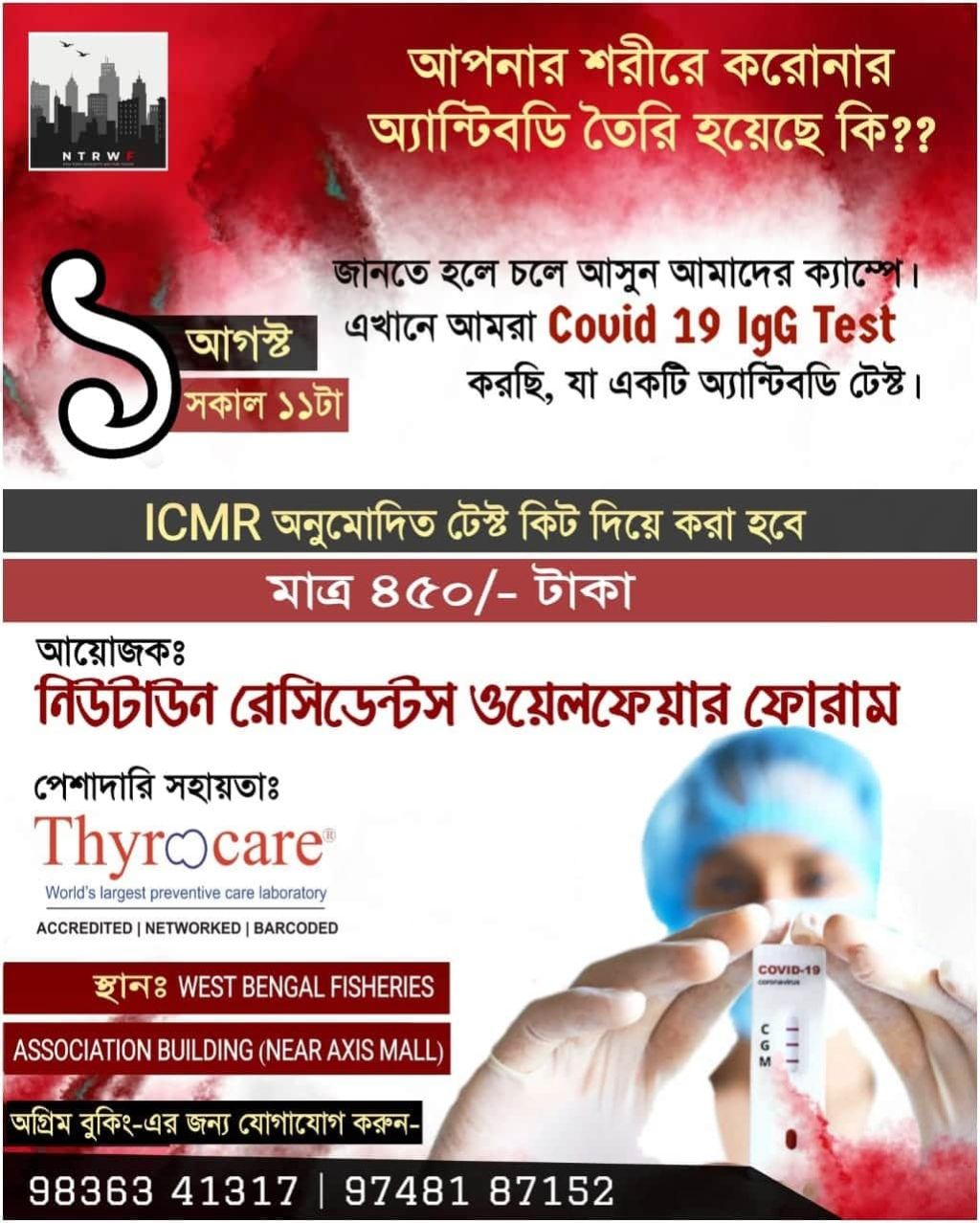
**This is not a Covid test, but IgG detection is an important aspect of serological surveys and finds out whether there has been a previous infection.**
**Serological survey** is possibly the most informative and straight forward technique available to deduce the dynamics of infection spread and also a population’s susceptibility and level of immunity.
These tests look for antibodies in blood and if such antibodies are found, it suggests that there has been a previous infection. The primary targets of the SARS CoV-2 (Covid 19) serology tests include five different type of antibodies and the total antibody count (Ref.2).
This epidemiological tool holds importance in estimating how common or prevalent Covid 19 is to GUIDE PROTECTIVE AND CONTROL MEASURES such as deciding quarantine and containment zones, in facilitating contact tracing and social distancing norms. It is also one of the key ways, epidemiologists check whether we are close to achieving “herd immunity”.
**What does positive report suggest?**
A positive IgG serology test suggest, that they have been infected with corona in the past. Since IgG is one of the key players in establishing post-infection Immunity, it suggests that there still is a substantial level of antibody left in your body and for the time being you are protected from further infection. It however does not answer whether you should be able to go back to work or in public places.(Ref.3)
**What serological tests do not answer?**
How many antibodies are required to protect someone from Covid 19?
How long will these antibodies last and whether there is a chance of reinfection?
The mere presence of IgG antibodies DO NOT guarantee protection from future infection. IgG however plays a significant role in long term immunity as previously pointed out. No re-infection was seen in Rhesus Macaque (the common monkey, Macaca Mulatta) who were exposed to SARS CoV-2 nearly a month after primary infection.
** A small study conducted in China in June and published in Nature Medicine (Ref.5), shows decline in antibodies within two or three months of infection. Another recent study at King’s College London, longitudinally evaluated antibody responses in SARS-CoV-2 infection of more than 90 patients and healthcare workers, and found steep drops in patients’ antibody levels three months after infection (Ref. 6).**
** What does a negative report mean? **
A negative report means you have not been exposed to Corona virus in the past but could also mean that your body hasn’t had enough time to produce these antibodies. The IgG also cannot be used to detect new infection because it takes about 2 weeks to develop this particular antibody. It could also mean that even though the infection occurred, your body did not form enough antibodies to be detected.
I have collected this writing and there maybe overlap with the sources. For detailed account, results and report do see,
**My References**
1. Use of serological surveys to generate key insights into the changing global landscape of infectious disease, Dr. CJE Metcalf et al., Lancet, 2016. https://www.thelancet.com/journals/lancet/article/PIIS0140-6736(16)30164-7/fulltext
2. https://asm.org/Articles/2020/May/COVID-19-Serology-Testing-Explained
3. https://www.cdc.gov/coronavirus/2019-ncov/covid-data/serology-surveillance/index.html
5.https://www.nature.com/articles/s41591-020-0965-6
6. https://www.medrxiv.org/content/10.1101/2020.07.09.20148429v1


Leave a Reply